Demo / Prototype
ROLE
TEAM
OVERVIEW
Problem
SKILLS
Ideation
Product Designer
3 Designers
Product Design
UX/UI Design
Growth & Retention Strategy
Clover Fitness: redesigning for retention
Clover, a fictional wearable health tech company created for this case competition, had strong technology and real user enthusiasm at launch but fewer than 20% of customers stayed past 30 days. Our team identified poor habit formation and a frustrating data input experience as the root causes, and redesigned the app experience to keep users engaged long after the first week.
Impact:
Retention growth by 2028
185%
$525M
+$120K
3.7M
Revenue above pre-2020 baseline
Projected users in subsequent years
Annual net income increase
We reviewed Clover's retention data, user demographics, and existing app interface to understand where the experience was breaking down.
Root cause 1: Tedious data Input
Root cause 2: No sense of progress
Root cause 3: Low health literacy among casual users
Users were prompted to manually log mood, caffeine intake, calories, and hydration every night. As one user noted in the case, logging everything consumed each day got tiring fast, and by the end of the day the details were already forgotten. That process simply did not fit naturally into daily life.
The app displayed raw biometric data but did not translate it into meaningful goals or milestones. Without visible progress, users struggled to justify the ongoing subscription cost.
The interface was designed with athletes in mind, leaving a growing segment of casual users overwhelmed by metrics they could not interpret or act on.
Despite strong early engagement, retention dropped from 60% at day 5 to just 30% at day 30. By 2024, market share had stalled at 10% while competitors like Oura Ring surpassed it at 10.6%. The product was accurate and well-built, but the app experience was not doing enough to keep users coming back.
We proposed three interconnected redesigns targeting each root cause, scoped for a phased rollout from 2026 to 2028.
Our redesign projected a 185% growth in user retention by 2028 and $525M in income above the pre-2020 baseline. The phased rollout, beginning with personalized suggestions in Q1 2026, was designed to validate each feature before scaling, reducing implementation risk while building momentum.
Rather than adding features for the sake of differentiation, every design decision was tied back to a specific retention barrier. Reducing manual input friction, making data feel personal rather than clinical, and adding social accountability together addressed the three core reasons users were leaving.
Personalized Suggestions
App Interface Revamp
Goal Setting and Tracking
An onboarding questionnaire powered by conversational AI collects lifestyle data upfront, then automatically predicts daily intake so users no longer need to manually log every detail at the end of the day. If the prediction is off, users can adjust it with one tap. This reduces friction while keeping the data accurate.
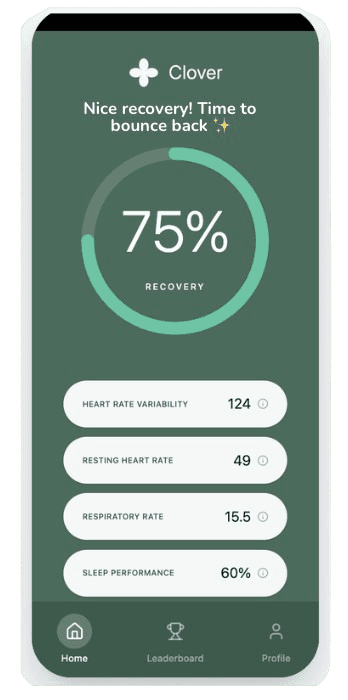
We redesigned how Clover presents data, shifting from raw numbers to data storytelling with positive reinforcement and plain-language insights. For athletes, we added a showcase-style summary report shareable with coaches and recruiters. For casual users, the interface surfaces only what is relevant to their goals with clear, encouraging language.
Users can now set personal health goals and track progress visually over time. For athletes, a verified performance profile visible to coaches and recruiters adds external motivation to stay engaged. For non-athletes, goal-based communities and wellness challenges create social accountability. Motivating notifications trigger when users hit milestones, reinforcing the habit loop.
Auditing the root causes of disengagement
This fitness app was losing users it already had
Three features designed to keep users engaged long-term
Turning a retention problem into a growth strategy
Why this problem?
Solution
Final Design
Results
What differentiates our approach?
How might we break down barriers to habit formation so users build a lasting relationship with their health data?
previous project


home
Pitch The Future, 2025
Western Founders Network